
GarageBand gives Mac users a capable recording setup, but a built-in microphone rarely flatters vocals. The right studio microphone can make demos sound clearer and more intentional. I compared nine options for GarageBand users.
Start with connectivity, because USB keeps setup simple while XLR opens the door to an audio interface. Room noise, vocal dynamics, macOS compatibility, and included accessories also matter. Your recording space should guide the final choice.
⚡ Quick Verdict
List of Best Studio Microphone For Garageband
| Image | Product | Score | Link |
|---|---|---|---|
 |
LCT540 Large-Diaphragm Studio Condenser Microphone | 9.2/10 |
View on Amazon Free Shipping & 30-Day Returns |
 |
Shure SM4 XLR Studio Condenser Microphone Kit for Recording | 9.0/10 |
View on Amazon Free Shipping & 30-Day Returns |
 |
MAONO PD200W Hybrid Wireless Podcast Microphone for PC, Dyna 🥈 Runner-Up |
8.9/10 |
View on Amazon Free Shipping & 30-Day Returns |
 |
FIFINE T669 Studio Condenser USB Microphone for Recording Po 🏆 Editor’s Pick |
8.7/10 |
View on Amazon Free Shipping & 30-Day Returns |
 |
Shure SM58 Pro XLR Dynamic Vocal Microphone | Cardioid dynam | 8.5/10 |
View on Amazon Free Shipping & 30-Day Returns |
 |
MAONO A04 Gen2 XLR/USB Condenser Microphone Kit for PC Podca | 8.4/10 |
View on Amazon Free Shipping & 30-Day Returns |
 |
FIFINE AmpliTank K688 Dynamic Microphone, XLR/USB Podcast Re | 8.3/10 |
View on Amazon Free Shipping & 30-Day Returns |
 |
MXL 990/991 Large & Small Diaphragm Condenser Microphone Bun | 8.0/10 |
View on Amazon Free Shipping & 30-Day Returns |
 |
Samson C01U Pro – USB Studio Condenser Microphone 💵 Budget Pick |
7.8/10 |
View on Amazon Free Shipping & 30-Day Returns |
📋 How We Evaluated
Evaluation focused on GarageBand compatibility, connection type, and sound quality for vocals and instruments. Build materials, included accessories, and ease of setup were weighed heavily. Value was assessed against typical home studio budgets, considering whether a separate audio interface is required.
Detailed Reviews
LCT540 Large-Diaphragm Studio Condenser Microphone
| Connection | XLR |
| Capsule Type | Condenser, large-diaphragm |
| Self-Noise | 4dB (A) |
| Special Feature | Perfect Match Technology, award-winning design |
What We Found
This large-diaphragm condenser focuses on highly detailed recording with an exceptionally low stated self-noise figure. That characteristic suits quiet sources and recordings that will receive heavy compression. Its design supports demanding processing while preserving a clean noise floor.
Consistent sensitivity across units can also help when matching microphones for stereo work. It is aimed at critical vocal and instrument recording rather than casual desktop use.
💬 My Take
My read is that this microphone belongs in a carefully built recording chain. I would pick it for quiet sources, detailed capture, and extensive processing.
Who It’s For
I would consider it for producers, sound engineers, and serious home-studio owners with treated rooms. It makes the most sense when low self-noise and fine detail matter more than a beginner-friendly budget. A capable interface is also part of the setup.
✅ Pros
- Ultra-low 4dB self-noise captures quiet sources without hiss.
- Perfect Match Technology ensures consistent sensitivity for stereo pairing.
- Handles extreme compression and processing without revealing noise.
❌ Cons
- Requires a high-quality audio interface with phantom power.
- Premium price point makes it inaccessible for beginners.
- XLR-only connection lacks USB convenience for quick GarageBand setup.
Shure SM4 XLR Studio Condenser Microphone Kit for Recording
| Connection | XLR |
| Capsule Type | Condenser, cardioid, 1-inch dual-diaphragm |
| Build | All-metal with integrated pop filter |
| Special Feature | Interference shielding, magnetic shock mount |
What We Found
This XLR condenser microphone targets detailed home-studio recording. Its 1-inch dual-diaphragm capsule is designed for controlled low frequencies and smooth high frequencies. The uniform cardioid pattern helps reject sound from the sides. Interference shielding addresses noise from phones and Wi-Fi routers.
Its larger sweet spot can make close-miking less sensitive to small distance changes. An audio interface with phantom power is required.
💬 My Take
My read is that this is the considered choice for a more serious XLR setup. I would shortlist it when clean capture and interference control justify extra hardware.
Who It’s For
I would look at it for home-studio owners, voiceover artists, and musicians with an interface already in place. It suits treated rooms and detailed vocal or acoustic-instrument work. The interference protection may matter in crowded electronic environments.
✅ Pros
- Brass dual-diaphragm capsule delivers smooth, detailed audio reproduction.
- Interference shielding blocks RF noise from common household devices.
- Integrated pop filter and shock mount reduce plosives and vibrations.
❌ Cons
- Requires an audio interface with phantom power, adding cost.
- Premium price point may exceed beginner budgets.
- XLR-only connection limits plug-and-play convenience for GarageBand.
MAONO PD200W Hybrid Wireless Podcast Microphone for PC, Dyna🥈 Runner-Up
| Connection | Wireless, USB, XLR |
| Capsule Type | Dynamic, cardioid, 30mm |
| Signal-to-Noise Ratio | 82dB |
| Max SPL | 128dB |
What We Found
This microphone stands out for offering wireless, USB, and XLR connections. Its 30mm dynamic capsule targets broadcast-style vocal reproduction, while the cardioid pattern helps limit room noise. The system can connect two wireless microphones to one receiver and record separate tracks.
That arrangement is especially useful for interviews and two-person podcasts. USB keeps setup accessible, while XLR leaves room for a more involved recording system later.
💬 My Take
My read is that the wireless option gives this microphone its clearest advantage. I would choose it for interviews, duo podcasts, or flexible desk recording.
Who It’s For
I would shortlist it for podcasters, interviewers, and creators who need movement around a recording space. Two-person shows benefit from separate tracks. It also makes sense for users who want wireless recording now, with USB and XLR available later.
✅ Pros
- Three connection modes offer unmatched flexibility for any setup.
- Wireless dual-mic support enables cable-free duo podcasts with separate tracks.
- MaonoLink app provides extensive EQ, reverb, and preset customization.
❌ Cons
- Wireless receiver and camera accessories sold separately add cost.
- Dynamic capsule may require more gain than condenser mics in quiet settings.
- App-based controls only work in USB mode, not wireless or XLR.
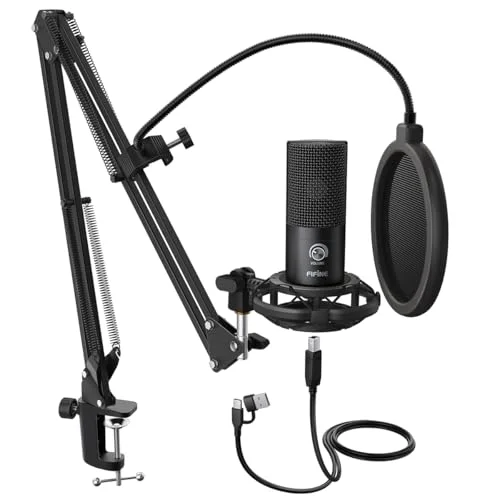
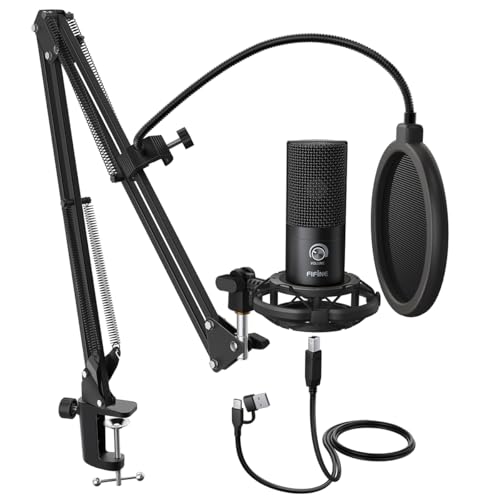
FIFINE T669 Studio Condenser USB Microphone for Recording Po🏆 Editor’s Pick
| Connection | USB-B to USB-A/C |
| Capsule Type | Condenser, cardioid |
| Included Accessories | Boom arm, shock mount, double pop filter, 8.2ft cable |
| Compatibility | PC, laptop (not Xbox) |
What We Found
This kit keeps GarageBand recording straightforward. USB connects directly to a Mac without an audio interface or extra drivers. The cardioid condenser capsule focuses on front-facing vocals while reducing ambient noise. The included boom arm adjusts vertically and horizontally, while the double pop filter helps control plosives.
The 8.2-foot cable gives you useful placement flexibility. It suits podcasts, voiceovers, and home recordings that do not need a complicated setup.
💬 My Take
My read is that this is an approachable first microphone for GarageBand. The USB connection and bundled accessories keep the setup pleasantly simple.
Who It’s For
I would point beginners, singer-songwriters, students, and home podcasters toward this kind of all-in-one setup. The included arm, shock mount, and pop filter remove several early purchases. It also suits anyone who wants to start recording without learning an interface first.
✅ Pros
- Complete kit includes boom arm, shock mount, and pop filter for immediate use.
- Plug-and-play USB connection works instantly with GarageBand on Mac.
- Sturdy steel boom arm allows precise positioning with wide adjustment range.
❌ Cons
- Condenser capsule picks up more room reflections than dynamic alternatives.
- No headphone jack for zero-latency monitoring during recording.
- Build quality is adequate but not as robust as premium studio microphones.
Shure SM58 Pro XLR Dynamic Vocal Microphone | Cardioid dynam
| Connection | XLR |
| Capsule Type | Dynamic, cardioid |
| Frequency Response | 50Hz-15kHz |
| Build | Rugged metal with reinforced grille |
What We Found
This dynamic vocal microphone uses a cardioid pattern to focus on the speaker and limit background noise. Its tuned response adds warmth and vocal presence, which can help voices sit clearly in a mix. The metal construction and reinforced grille suit regular stage use.
GarageBand users need an audio interface with enough gain. It is especially relevant for live recording, loud vocals, and other sources that do not need a sensitive condenser.
💬 My Take
My read is that this remains a dependable dynamic option for live vocals and noisy spaces. I would shortlist it when durability and background-noise rejection matter.
Who It’s For
I would consider it for performers, singer-songwriters, and podcasters recording in less-than-ideal rooms. It makes the most sense when an interface or mixer is already available. Beginners seeking direct USB connection should choose a different type of microphone.
✅ Pros
- Legendary durability and build quality that withstands decades of use.
- Cardioid pattern rejects background noise and feedback effectively.
- Integrated pop protection reduces plosives without extra accessories.
❌ Cons
- Requires an audio interface and preamp with ample gain for quiet sources.
- Dynamic capsule captures less detail than condensers in studio settings.
- No USB option means extra cost for beginners without existing gear.
MAONO A04 Gen2 XLR/USB Condenser Microphone Kit for PC Podca
| Connection | USB and XLR |
| Capsule Type | Condenser, cardioid, 16mm |
| Sampling Rate | 192kHz/24-bit |
| Frequency Response | 30Hz-16kHz |
What We Found
This condenser microphone offers both USB and XLR connections, so the setup can grow with your recording system. Its stated 192kHz/24-bit capability supports high-resolution recording. The cardioid pattern helps reduce off-axis noise. In USB mode, the companion software adds noise reduction, EQ presets, compression, and limiting.
The included pop filter and foam windscreen address plosives and breath noise. It suits vocals, voiceovers, podcasts, and acoustic instruments.
💬 My Take
My read is that this microphone offers useful room to grow. I would pick it when USB convenience and future XLR flexibility both matter.
Who It’s For
I would look at it for creators who want a simple USB start without giving up an XLR route. Musicians and voiceover artists may appreciate the software controls. It also suits home studios that expect their setup to evolve.
✅ Pros
- Dual USB and XLR connectivity provides flexibility for any setup.
- High-resolution 192kHz/24-bit recording captures detailed audio.
- MaonoLink software offers extensive EQ, noise reduction, and dynamics control.
❌ Cons
- XLR mode requires phantom power, adding cost for beginners.
- Software features only function in USB mode, limiting XLR utility.
- Condenser design picks up more room noise than dynamic alternatives.
FIFINE AmpliTank K688 Dynamic Microphone, XLR/USB Podcast Re
| Connection | USB and XLR |
| Capsule Type | Dynamic, cardioid |
| Max SPL | 130dB |
| Controls | Tap-to-mute, gain knob, headphone volume |
What We Found
This dynamic microphone combines USB and XLR outputs, giving GarageBand users two connection paths. Its metal construction and 130dB SPL handling suit louder sources. The cardioid pattern helps reduce background noise. USB mode adds a tap-to-mute button, gain control, and headphone monitoring. XLR connection supports a more traditional interface-based setup.
Those controls make it practical for podcasts, streams, voiceovers, and spoken recordings.
💬 My Take
My read is that the physical controls make this dynamic microphone especially practical. I would choose it for mixed USB and XLR workflows.
Who It’s For
I would point podcasters, streamers, gamers, and voiceover artists toward it when onboard controls matter. USB suits beginners, while XLR gives experienced users another route. It is a sensible fit for creators who want dynamic noise rejection without losing plug-and-play access.
✅ Pros
- Dual XLR and USB outputs offer flexibility for any recording setup.
- Tap-to-mute and gain control provide convenient hardware adjustments.
- Headphone jack enables real-time monitoring without latency.
❌ Cons
- Boom arm, mic stand, and XLR cable are not included.
- Monitoring and gain controls only work in USB mode.
- Dynamic capsule may require high gain for quiet vocalists.
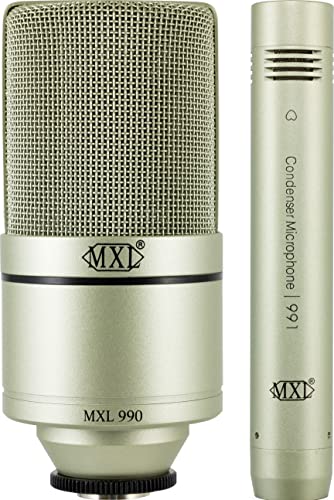
MXL 990/991 Large & Small Diaphragm Condenser Microphone Bun
| Connection | XLR |
| Capsule Type | Condenser, cardioid (large and small diaphragm) |
| Frequency Response | 20Hz-20kHz (990), 30Hz-18kHz (991) |
| Included Accessories | Shock mount, pop filter, 20ft XLR cable |
What We Found
This bundle combines a large-diaphragm condenser for vocals with a small-diaphragm model suited to acoustic instruments. The larger microphone uses a gold-sputtered diaphragm and transformer-balanced output for detailed vocals. The smaller model emphasizes a silky high end. Both use cardioid pickup and require 48V phantom power.
A shock mount, pop filter, and 20-foot XLR cable are included, which broadens the kit’s immediate usefulness.
💬 My Take
My read is that the two-microphone format gives this bundle its strongest appeal. I would choose it when vocals and acoustic instruments share the same recording plans.
Who It’s For
Home studio enthusiasts wanting to record both vocals and acoustic instruments will appreciate this bundle. Singer-songwriters can use the 990 for vocals and the 991 for guitar. Podcasters and voiceover artists get a capable large-diaphragm option.
Beginners with an audio interface providing phantom power will find it a cost-effective way to expand their mic locker. It suits those who want tonal variety without buying separate microphones.
✅ Pros
- Two microphones provide versatile vocal and instrument recording options.
- Includes shock mount, pop filter, and cable for immediate use.
- Warm, detailed sound quality from gold-sputtered diaphragms.
❌ Cons
- Requires +48V phantom power, necessitating an audio interface.
- Condenser design picks up room noise without treatment.
- Build quality is decent but not as rugged as premium alternatives.
Samson C01U Pro – USB Studio Condenser Microphone💵 Budget Pick
| Connection | USB |
| Capsule Type | Condenser, supercardioid, 19mm |
| Frequency Response | 20Hz-20kHz |
| Monitoring | Headphone output with zero-latency |
What We Found
This USB condenser microphone keeps the recording chain uncomplicated. Its 19mm diaphragm is designed to capture detailed audio, while the supercardioid pattern narrows the pickup area. The headphone output provides zero-latency monitoring, which is useful for recording vocals in GarageBand. Its 16-bit, 44.1/48kHz resolution covers typical GarageBand projects.
Because condensers hear more room detail, placement and room treatment remain important.
💬 My Take
My read is that the monitoring output gives this simple USB microphone a practical edge. I would choose it for uncomplicated home recording and vocal demos.
Who It’s For
Budget-conscious beginners and home recordists seeking a simple USB microphone will find the C01U Pro appealing. Singer-songwriters recording demos in GarageBand will appreciate the zero-latency monitoring. Podcasters and voiceover artists on a tight budget get solid audio quality.
Students and hobbyists who want a plug-and-play solution without extra gear will benefit. It is best for those recording in treated rooms, as the sensitive condenser picks up ambient noise easily.
✅ Pros
- Zero-latency headphone monitoring is rare at this price point.
- Large 19mm diaphragm captures detailed, studio-quality audio.
- Supercardioid pattern offers tight focus and good off-axis rejection.
❌ Cons
- Plastic build feels less durable than metal-bodied competitors.
- No included accessories like boom arm or shock mount.
- Supercardioid pattern requires careful placement to avoid proximity effect.
What to Look For Before Buying
Choosing a GarageBand microphone comes down to connection type, capsule design, room conditions, and future plans. USB keeps recording accessible, while XLR requires more equipment but supports a flexible signal chain. Dynamic and condenser microphones also behave differently around noise and detail.
Check USB vs XLR Connectivity
USB microphones connect directly to a Mac, which suits beginners and portable GarageBand sessions. XLR microphones need an audio interface, and condenser models usually need phantom power. That extra hardware costs more, but it leaves room for upgrades. Choose USB for simplicity, or XLR if your recording setup will grow.
Value Capsule Type: Dynamic vs Condenser
Dynamic microphones generally handle loud sources and untreated rooms well. Condenser microphones capture more detail, which can benefit vocals and acoustic instruments. They also hear more room sound and usually need phantom power through XLR. Match the capsule to your room before focusing on specifications.
Rating Build Quality and Accessories
Metal construction usually makes a microphone better suited to frequent handling. A shock mount can reduce vibration, while a pop filter controls vocal plosives. Boom arms help position the microphone consistently. Bundled accessories may matter more than small specification differences during an initial setup.
Verify GarageBand Compatibility and Monitoring
Most class-compliant USB microphones should work with GarageBand through macOS Core Audio. XLR microphones depend on an interface that macOS recognizes. Headphone monitoring can reduce recording delay, especially when a microphone includes zero-latency monitoring. Check the connection, monitoring method, and required power before buying.
Frequently Asked Questions
Can I use an XLR microphone with GarageBand without an audio interface?
No. An XLR microphone needs an audio interface or mixer between the microphone and Mac. The interface converts the analog signal for GarageBand. Some microphones include both USB and XLR outputs, while pure XLR models need an interface. Check whether condenser microphones also require phantom power.
Do USB microphones work with GarageBand on Mac?
Yes, most class-compliant USB microphones work with GarageBand on Mac. Connect the microphone, then select it as the input in GarageBand preferences. Extra drivers are usually unnecessary. USB remains the simplest route for a beginner.
What is the difference between dynamic and condenser microphones for GarageBand?
Dynamic microphones are less sensitive and often suit loud sources or untreated rooms. Condenser microphones capture more detail, which benefits vocals and acoustic instruments. Condensers usually need phantom power through XLR. Your room and recording source should decide between them.
Do I need a pop filter for recording vocals in GarageBand?
A pop filter is useful for vocals because it softens bursts from P and B sounds. Many microphone kits include one. Mic distance and angle also help control plosives. The filter does not replace good recording technique.
How do I reduce background noise when recording with a studio microphone?
Start with a cardioid or supercardioid microphone and keep unwanted sound behind its rejection area. Soft furnishings can reduce room reflections. Dynamic microphones often pick up less room sound than condensers. Careful gain setting and software noise reduction can further clean the recording.
🎯 Final Verdict
For many GarageBand beginners, a bundled USB condenser microphone is the simplest starting point. It can include the arm, shock mount, and pop filter needed for immediate recording. A hybrid wireless microphone makes more sense for interviews or two-person podcasts.
Choose based on your room, connection needs, and expected recording style.

Leave a Reply